
Chapter 1
Chapter 1: Your License
Florida Classified Driver Licenses
The Department of Highway Safety and Motor Vehicles issues the following classes of licenses: Class A, B, C, D, and E.
- Classes A, B, and C are for drivers of commercial motor vehicles such as large trucks and buses.
- Classes D and E are for drivers of non-commercial vehicles.
NOTE: There is a separate manual entitled Commercial Driver License Manual for Truck and Bus Drivers. This manual is available at any driver license office. If you wish to drive a commercial motor vehicle as defined below, you must be properly tested and licensed to do so.
Who Needs One?
If you live in Florida and want to drive a motor vehicle on public streets and highways, you are required to have a State of Florida Driver License.
If you move to Florida and have a valid license from another state, you must get a Florida license within 30 days of becoming a resident. You are considered a resident of Florida if you:
- enroll your children in public school, or
- register to vote, or
- file for a homestead exemption, or
- accept employment, or
- reside in Florida for more than six consecutive months.
Who Does Not Need One?
The following persons may drive in Florida without having a Florida driver license if they have a valid license from another state or country:
- Any non-resident who is at least 16 years old.
- Persons employed by the United States Government driving a United States Government motor vehicle on official business.
- Any non-resident working for a firm on a contract for the United States Government. (This exemption is only for 60 days.)
- Any non-resident attending college in Florida.
- Persons who drive only vehicles like farm tractors or road machines temporarily on the highway may drive without a license.
- A licensed driver who lives in another state and travels regularly between his home and work in Florida.
- Non-resident migrant farm workers even though they are employed or place children in the public schools, providing they have a valid license from their home state.
- Members of the Armed Forces stationed in Florida and their dependents, with these exceptions:
- Service member or spouse claims homestead exemption (All drivers in family must obtain Florida licenses),
- Service member becomes employed (All drivers in family must obtain Florida licenses),
- Spouse becomes employed (Spouse and children who drive must obtain Florida licenses),
- Child becomes employed (Only employed child who drives must obtain Florida license).
Learner's Driver License
A person who holds a Learner's License must be accompanied by a licensed driver, 21 years of age or older, who occupies the front passenger seat closest to the right of the driver.
Drivers can only drive during daylight hours for the first three months from the original issue date when accompanied by a licensed driver, 21 years or older who occupies the front passenger seat.
After the first three months, drivers may operate a vehicle from 6 a.m. to 10 p.m. with a licensed driver, 21 years or older in the front passenger seat.
NOTE: Drivers with a Learner's License are ineligible for a motorcycle endorsement.
Requirements:
- Be at least 15 years old.
- Pass vision, road signs and road rules tests.
- Have the signature of one parent (or guardian) on the consent form if under age 18.
- Completion of Traffic Law and Substance Abuse Education Course.
- Two forms of identification.
- Social Security Number.
- Must be in compliance with school attendance.
The 2000 Florida Legislature amended section 322.05, Florida Statutes, changing the requirements to obtain a Class E license for a driver under the age of 18 holding a learner's license. The following requirements must be met in order to obtain a regular Class E license if a learner's license is issued on or after October 1, 2000:
- Must hold a Learner's License for at least 12 months or until the 18th birthday.
- Must have NO convictions 12 months from the issue date of the learner's license.
- May have one traffic conviction within 12 months from the issue date of the learner's license if adjudication is withheld.
- A parent, legal guardian, or responsible adult over 21 years old must certify that the driver has 50 hours driving experience, including 10 hours of night time driving.
Parent's Consent for Minors
If you are under 18 and are not married, your license application must be signed by one parent or legal guardian. STEP-PARENTS MAY NOT SIGN FOR YOU UNLESS THEY HAVE LEGALLY ADOPTED YOU.
The application must be signed in front of the examiner or a notary public. Whoever signs your application agrees to take responsibility with you for your driving. If the signer decides not to accept responsibility for your driving, your license will be canceled. To cancel the license, the signer must write a letter to the department requesting to withdraw their consent for the minor driver. I include the complete name, date of birth and driver license number of the minor driver in the letter.
THE CONSENT FORM MUST BE NOTARIZED OR SIGNED IN THE PRESENCE OF THE EXAMINER.
Identifying Yourself
State law requires identification, proof of date of birth and social security number from all customers before a driver license or identification card can be issued. Each applicant for an original (first time) driver license or identification card MUST present one of the following as his or her primary identification document:
PRIMARY IDENTIFICATION
- United States birth certificate, including U.S. territories and District of Columbia. (Original or Certified Copy).
- Valid United States passport (not expired).
- Alien Registration receipt card (not expired).
- Employment authorization card issued by the United States Department of Justice (not expired).
- Proof of non-immigrant classification provided by United States Department of Justice (Form I94 not expired or Certificate of Naturalization)(not expired).
In addition, a secondary identification document is required and may include, but is not limited to, the original or certified copy of one of the following:
SECONDARY IDENTIFICATION
- School record stating date of birth, which must contain the registrar's signature.
- Transcript of the birth record filed with a public officer charged with the duty of recording certificates.
- Baptism certificate, which shows date of birth and the place of baptism.
- Family bible record or birth announcement in a baby book.
- An insurance policy on the customers life which has been in force for at least two years and which has the month, day and year of birth.
- A military or military dependent identification card.
- Florida or another state driver license, valid or expired (may also serve as a primary item).
- Florida license record or identification card record.
- Selective Service Registration (Draft Card).
- Florida Vehicle Registration certificate (HSMV 83399, owner's copy) obtained from the tax collector's office where the customer's vehicle was registered, Florida, or out-of-state registration certificate, if name and date of birth are shown.
- Florida and out of state, non-driver identification cards (may also serve as a primary item).
- Receipt copy of your last Florida driver license issuance.
- Immigration form I-571.
- Federal form DD-214 (military record).
- Marriage certificate.
- Court order, which includes legal name.
- A Florida voter registration card which was issued at least three months previously.
- Personal identification by an examiner or by a person well known to the examiner.
- Social Security Card.
- Parent Consent Form (HSMV 71022).
- Out-of-country driver license or identification car, government issued.
If you have legally changed your name by marriage or court order, you must submit the original or a certified copy of your marriage certificate or court order.
No photocopies will be accepted unless certified by the issuing authority.
NOTE: A secondary identification from the above list is required. The Social Security Number (if issued) MUST be included on the application for a driver's license or identification card.
Traffic Law and Substance Abuse
If you have never been issued a license in any jurisdiction (state or country), you are required to complete a traffic law and substance abuse education course before you will be issued a license. Consult your local phone directory for locations in your area.
Driver Education
Driver education courses can help you develop the skills you need to be a safe driver. You can obtain more information by referring to your local telephone directory under Driving Instruction or Traffic Schools.
Third Party Testing
Many Driver Education teachers assist the Department of Highway Safety and Motor Vehicles (DHSMV) in licensing new drivers. Students who satisfactorily complete the DHSMV-approved Driver Education Licensing Assistance Program (DELAP) courses in participating public or private schools may receive DHSMV waiver certificates from their driver education teacher. These certificates, when presented to the local driver license office, will be used to replace the DHSMV written and/or driving tests for issuance of a learner's driver license or Class E license. DHSMV may, however, test any student on a random basis before issuing a driver license. The waiver certificates are valid for one year from the original date of issuance.
Restriction and Endorsement Codes on Florida Licenses
Restriction Codes:
A = CORRECTIVE LENSES means a person must wear corrective lenses at all times when operating a vehicle.
B = OUTSIDE REARVIEW MIRROR (Left Side) means the vehicle the person is driving must have a left outside rearview mirror on the car.
C = BUSINESS PURPOSES ONLY means the person can only drive to work and on-the-job, for education purposes, to church and for medical purposes.
D = EMPLOYMENT PURPOSES ONLY means the person can only drive to work and on-the-job.
E = DAYLIGHT DRIVING ONLY means the person can only drive during daylight hours.
F = AUTOMATIC TRANSMISSION means the person can only drive a vehicle that has automatic transmission.
G = POWER STEERING means the person must drive a vehicle with power steering.
I = DIRECTIONAL SIGNALS means a person must drive a vehicle equipped with mechanical directional signals.
J = GRIP ON STEERING WHEEL means the vehicle must be equipped with a knob or grip on the steering wheel.
K = HEARING AID means the person must wear a hearing aid at all times while driving the vehicle.
L = SEAT CUSHION means the person must use a seat cushion at all times while driving.
M = HAND CONTROLS OR PEDAL EXTENSION means the vehicle must be equipped with hand controls or a pedal extension.
N = LEFT FOOT ACCELERATOR means the vehicle must be equipped with a left foot accelerator.
P = PROBATION-INTERLOCK DEVICE means the vehicle must be equipped with a device that locks the ignition at times specified by the court imposing the restriction.
S = OTHER RESTRICTIONS means there are other restrictions imposed on this license.
T = NO PASSENGERS ON MOTORCYCLE means the person cannot have passengers when driving a motorcycle.
X = MEDICAL ALERT BRACELET means the person must wear a medical alert bracelet at all times while driving the vehicle.
Y = EDUCATIONAL PURPOSES ONLY means the person can drive for educational purposes.
Restriction Codes Appearing on Commercial Driver Licenses Only:
1 = VEHICLES W/O AIR BRAKES — issued to those who have not passed the required written and/or skills tests for the operation of vehicles with air brakes.
2 = CDL-INTRASTATE ONLY (CMV) — issued to those who are authorized to operate commercial motor vehicles inside Florida only.
3 = BUS ONLY (CMV) — issued to persons who took written and skills tests which authorize them to drive commercial motor vehicles that are buses only.
4 = CMV<- 26,001 LBS Gross Vehicle Weight Rating
5 = NO TRACTOR /TRAILERS
6 = NO CLASS A PASSENGER VEHICLES
7 = NO CLASS B PASSENGER VEHICLES
NOTE: Drivers with a restriction on their license who do not comply with the requirements of the restriction can be issued a citation for violation of restriction and could be suspended. Offenses of this type are a second degree misdemeanor, except for violations of restriction code X.
Endorsement Codes
The following endorsements are placed on Class A, B, or C commercial driver licenses and on certain Class D licenses:
E = EMERGENCY VEHICLES — issued to those who drive an emergency vehicle, that is a commercial motor vehicle, but are exempt by law from obtaining a commercial driver license.
F = FARM CMV — issued to those who drive farm type commercial motor vehicles, but who are exempt by law from obtaining a commercial driver license.
H = PLACARDED HAZMAT — issued to those who have passed the required written and skills tests and who will transport placarded hazardous materials.
N = TANK VEHICLES — issued to those who have passed the required written and skills tests and who will drive tank vehicles.
P = PASSENGERS — issued to those who have passed the required written and skills tests and who will drive passenger vehicles.
T = DOUBLE/TRIPLE TRAILERS — issued to those who have passed the required written and skills tests and who will drive double or triple tractor trailer vehicles.
X = PLACARDED HAZMAT and TANK VEHICLES — issued to those who qualify for endorsements H and N.
Physical and Mental Requirements
You must list any physical or mental problems on your license application which might affect your driving. Many of the physical problems can be handled by placing restrictions on your license. If you have epilepsy, fainting spells, dizziness, blackouts or any other medical condition that could impair your driving, you may be asked to have your doctor complete a medical report form. These forms may be requested through your local driver licenses office and will be mailed directly to you. The report must be completed by your doctor and submitted to the Department before a license can be issued.
If you are diabetic, and use insulin, you may request that it be indicated on your license.
Test Requirements*
Person applying for original Florida licenses will be required to take the following tests:
- Learner's Driver License — vision, hearing, road signs, and Class E road rules.
- Class E license — vision, hearing, road signs, Class E road rules and driving test.
- Class D license — vision, hearing, road signs, Class D road rules and driving test (driving test not required if applicant holds valid Florida Class E operator's license).
NOTE: Persons holding valid licenses from other states, U.S. possessions, France, or Canada are only required to take a vision test unless their driving ability is questionable. Persons holding a license from Germany and Taiwan are required to take the vision, hearing and written exam unless their driving ability is questionable. - Motorcycle endorsement — In addition to the above tests, applicants requesting motorcycle endorsements must pass the written motorcycle knowledge test and on-cycle skill test (unless they have a motorcycle endorsement on their out-of-state license.) See Florida Motorcycle Handbook for motorcycle information.
- Commercial driver licenses — see Florida Manual for Truck and Bus Drivers for required exams.
*All vehicles used for driving or on-cycle skill tests will be inspected by the examiner.
Purpose of Driver License Examination
The purpose of the license examination is to find out several things:
- Can you read and understand road signs, traffic signals and highway markings?
- Do you know the Florida driving rules?
- Can you see well enough to drive safely?
- Do you have the skill and experience to drive safely?
- Do you have any physical or mental handicaps that would affect your driving?
Examination Information
Vision test — standard vision screening.
Lenses or Glasses:
- You will be restricted to wearing corrective lenses when you drive if you need to wear contact lenses or glasses to pass the test.
- Telescopic lenses — you will not be eligible for a driver's license if you wear glasses with telescopic lenses.
Requirements:
Your driving privilege will be revoked if you are unable to meet the rules of vision standards. To pass you must meet the following vision standards with or without corrective lenses:
- Have 20/40 (or better) vision in each and both eyes. With or without corrective lenses.
- If you have 20/200 (or worse) vision in one eye, you must have 20/40 (or better) vision in the other eye. With or without corrective lenses.
- If you have 20/70 (or better) vision in either eye separately, or in both eyes together. The worst eye must have a vision screening better than 20/200. With or without corrective lenses. Referral to an eye doctor may be required.
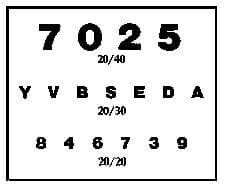
Preliminary Sample Vision Test
Road sign test: — Multiple choice test which consists of 20 road signs for you to identify by color, shape or meaning.
Road rules test: — Multiple choice test which consists of 20 questions regarding Florida traffic laws.
Vehicle inspection: — Your vehicle will be inspected to determine it is safe for a road test.
Driving test:
- You must provide the vehicle for the driving test.
- Proof of personal injury protection insurance and valid vehicle registration must be provided on the vehicle for the driving test.
- If you do not have a valid license you must be accompanied by a licensed driver.
- Persons with a learner's license you must be at least 16 years of age and have held the learner's license for 12 months.
- No one may accompany you and the examiner(s) during the driving test.
You will be expected to perform the following maneuvers on the driving test:
- turn about — Turn your car around in a 30' to 40' space
- shift gears — Change gears smoothly and correctly (if your car has a manual shift transmission).
- approach of crossing — Get in the proper lane and look in each direction. Change gears smoothly and correctly (if your car has a manual shift transmission).
- observe right-of-way — Allow pedestrians to cross, pull over and stop for emergency vehicles and do not enter an intersection when you will interfere with other traffic.
- straight-in parking — Park your vehicle inside the parking space straight-in. When properly parked, the vehicle should be centered, inside the space with no part of the vehicle extending out in the traffic lane. This maneuver gives the examiner the opportunity to observe your ability to:
- handle the vehicle in close quarters
- judge distance
- maintain control of the vehicle as you turn into a straight-in parking space
- stop quickly — Drive at 20 miles per hour and make a quick, safe stop when the examiner instructs you.
- backing — Back for a distance of 50 feet at a slow speed. Do not use the rear-view mirror when backing. Look to the rear instead.
- obey stop signs — Give the proper signal if turning, approach in the proper lane, come to a complete stop before reaching the pedestrian crosswalk or stop line, and remain stopped until you can move safely without interfering with cross traffic.
- obey traffic signals — Get into the proper lane and approach the light at a speed that will allow you to stop if the light should change. When you must stop, stop before the pedestrian crosswalk or stop line. When the light turns green, do not move forward until the other traffic has cleared the intersection. Give the correct signal for stopping and turning. Watch for "no turn"and "one way" signs.
- signal and turn — Get into the proper lane and signal your turn for the last 100 feet. You may use either hand signals or mechanical signals. Slow before reaching the crosswalk and turn into the proper lane.
- passing — Always look ahead and behind to make sure you can pass safely. Pass on the left, unless the car ahead is about to make a left turn or is in the left turn lane on a street with more than one lane in each direction. Do not pass on the shoulder (side of the road).
- stay in proper lane — Drive in the right lane except on a one-way street. Do not change lanes until you may do so safely.
- follow at a safe distance — Do not drive too closely behind other cars. Use the Two Second Rule
- use proper posture — Keep both hands on the steering wheel and do not rest your elbow in the window.
The examiner will explain any mistakes you may have made, after the test is completed. If you disqualify on the driving test you will be asked to study or practice before you return for another test. You will be asked to return another day for additional tests due to the volume of driving tests, which are conducted at each driver license location. If you pass the examination, the examiner will collect the fee and issue your license. If you surrender a valid learner's license, you are not charged additional fees for the replacement Class E license when you pass the driving test.
Appointments
Appointments are recommended, but not required for many of the services provided by the driver license offices. Contact your local driver license office to determine if an appointment is required for the service you need. Call in advance for your appointment and report at least five minutes before your scheduled time. You may still appear at the driver license office without an appointment, however, the fastest service is provided through the use of appointments.
Change of Address
You must obtain a new license showing your new address within 10 days of the change. You may change the address on your driver license or ID card by:
- Using your home touch-tone telephone and calling 1-866-467-3639. There is a $2.90 service fee plus the $10 license fee.
- By mail being sure to include your name, new address, driver license number, and date of birth. Mail to Division of Driver Licenses, Mail Stop 92, Post Office Box 5775, Tallahassee, Florida 32314-5775. Include a $10 check or money order payable to DHSMV. You will receive the appropriate corrections by mail. Allow 30 days for processing.
- Visiting your local driver license office.
- Internet at http://express.hsmv.state.fl.us. There is a $3 service fee plus the $10 license fee.
- Florida law requires that you destroy your old license when you receive the new license.
NOTE: If you fail to report a change of address, you may not receive your motor vehicle registration renewal or your driver license renewal. If you are pulled over by law enforcement and the address on your driver license is incorrect, you may receive a citation.
Name Change:
You must bring a court order or marriage certificate to a driver license office to prove your name change within 10 days of the change. Documents must be original or certified copies.
Duplicate License
If your driver license is lost or stolen, apply for a duplicate immediately. At your driver license office you will need to:
- Sign a statement that you have lost your license
- Show your identification
- Pay the duplicate license fee ($10.00).
Renewing Your Driver License
Driver licenses are valid for four or six years. Original (first time) and renewal applicants, who have a conviction-free record for the past three years and no suspensions or revocations for the past seven years, will be issued a six-year license.
Renewal at a Driver License Office
Before you renew your license, your driving record is checked. You will be issued a six year license if your driving record is free from convictions for driving violations in the past three years, or free from suspension/revocation/disqualifications for the past seven years. You may also be asked to take additional exams if the examiner has a reason to question your driving skills.
Your license may not be renewed if:
- You are not qualified to receive a license.
- You did not answer a summons, which involved a traffic violation.
- Your driver license is suspended or revoked or canceled.
Renewal by Mail, Internet or by Telephone
- Drivers may renew through the mail for two consecutive license expirations. You may receive a mail-in renewal packet approximately 30 days prior to license expiration. There are no additional fees for renewing by mail.
- You can renew by internet at http://express.hsmv.state.fl.us. There is a $3 service charge in addition to the renewal fee.
- You can renew by phone by calling 1-866-467-3639. There is a $2.90 service fee.
After your request is processed, you will receive a four or six-year renewal sticker to be placed on the back of your current license. Drivers with a digital license will receive a new license. Drivers with a digital license will receive a new license. Florida law requires that you destroy your old driver license after receiving the new license.
NOTE: Expiration dates may vary for driver licenses issued to Non-U.S. citizens.
Military Renewal by Mail
Members of the US Armed Forces serving on active duty outside of Florida may renew their licenses by mail without examination. Their spouses and children living with them may do the same. At least 3 months prior to the expiration of your licenses, write to: Division of Driver Licenses, 2900 Apalachee Parkway, Tallahassee, Florida 32399-0575 or e-mail from our web site. Give your name as it appears on your license, the driver license number, your date of birth and out-of-state address and zip code. The department will advise you further by return mail.
Veterans
Any veteran honorably discharged from the Armed Forces, who has been issued a valid identification card by the Division of Veteran's Affairs of the Department of Administration and has been determined by the Veteran's Administration to have a 100% service-connected disability and who is qualified to obtain a Class E or Class D license, is exempt from paying initial, renewal and motorcycle endorsement fees.
Identification Card
If you need an identification card, you can apply for one at any driver license office. To get the identification card, you must:
- Be 12 years old or older. Any person can be issued an identification card if applying for a disabled parking permit.
- Present your official Social Security card that was issued by the Social Security Administration.
- Present identification.
The card will contain your color photograph, full name, sex, race, address, date of birth, and other data Department may require. Identification cards are valid for 4 years. Citizens 60 years age or older be issued "non-expiring" identification card.
NOTE: Expiration dates may vary for identification cards issued to Non-U.S. citizens.
Driver licenses Agents (Tax Collectors)
Your local tax collector may provide full or limited driver license services. Additional service fees may be changed if you obtain a driver license or identification card from a licensed agent. Please contact your local tax collector for additional service fee information.
Selective Service
State law requires any male that is a U.S. citizen or immigrant, who is at least 18 years old but less than 26 years old, to comply with federal Selective Service System requirements when applying to receive a driver license, a commercial driver license, an identification card, or a renewal or duplicate card or license. Any driver license or identification card application consents to the Federal Selective Service System requirements.
Fees for License | |
| Initial License Fee for first Florida license, any type except commercial driver licenses | $20 |
| Learner's Driver License | $20 |
| Class E Renewal | $15 |
| Class D Renewal | $15 |
| Commercial Driver License | $50 |
| Duplicate License (if a license is lost or destroyed) | $10 |
| Stolen License-if police report filed | No fee |
| Replacement License (you must turn in the incorrect license) | $10 |
Examination and Other Fees | |
| Written Examination Re-Tests | $5 |
| Skill/Driving Examination Re-Tests | $10 |
| Commercial Driver License Endorsements | $5 |
| Motorcycle Endorsement | $5 |
| Identification Card — Original | $3 |
| Identification Card — Renewal | $10 |
| Duplicate Identification Card (If identification card is lost or destroyed or if you need an address chanage) | $10 |
| Delinquent Fee (paid if license expired less than 12 months before renewal application) | $1 |
Service Fees | |
| Administrative Fee Alcohol & Drug-Related Offenses (in addition to any other required fees) | $115 |
| After a license has been revoked | $60 |
| After a license has been suspended for failure to comply (pay, appear in court, or driver improvement school) with court requirements for a traffic ticket | $47.50 |
| After a license has been suspended | $35 |
| After a license has been suspended for Worthless Check(s) | $45 |
| After a license has been disqualified | $60 |
Insurance Suspension FeesFailure to maintain PIP insurance: | |
| (1st suspension) | $150 |
| (2nd suspension) | $250 |
| (3rd suspension) | $500 |
| Under the Financial Responsibility law failure to carry liability insurance | $15 |
| Note: If you are suspended under both the PIP and the liability law, you can be charged both reinstatement fees. | |
Florida Organ and Tissue Donor Program
Through the miracle of transplantation, many people here in Florida are living healthy, productive lives. However, the need for donated organs and tissues to outpace the supply. Right now, there are thousands who would be helped if more of us became organ and tissue donors. Organ and tissue donations provide each of us with a special opportunity to help others.
Donation of vital organs and tissues can save lives where no other hope is available. Heart, liver, lung and kidney transplants save lives everyday. Additionally, bone, skin, and cornea transplants often restore sight and save burn victims.
How Can You Help?
- Indicate your desire to donate organs and tissues on your Florida drivers license or identification card.
- Tell your nearest relative or legal guardian.
- Donate a minimum of $1 to fund organ and tissue donor education
- ALL OF THE ABOVE
Voluntary Contributions
When you are applying for a driver license or identification card, you may voluntary contribute to the following special trust funds:
Election Campaign — $5 minimum to be transferred to the Election Campaign Financing Trust Fund.
Florida Organ and Tissue Donor Education and Procurement Trust Fund — $1 minimum for organ and tissue donor education and for maintaining the organ and tissue donor registry.
Florida Council of the Blind — $1 minimum for assisting persons who have already been diagnosed as blind.
Hearing Research Institute — $2 minimum for infant hearing screening in Florida.
Juvenile Diabetes Foundation International — $1 minimum contribution